
Hair Care
5 min read

Dentestha Team
13/07/2026
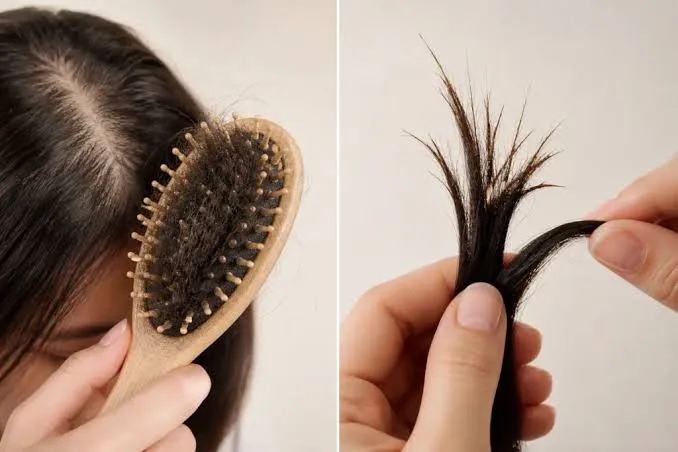
You notice more hair on your pillow, in the shower, or on your clothes. But is your hair actually falling from the roots, or is it breaking somewhere along the length?
These two problems can look similar, but they are not the same. Understanding the difference can help you figure out what your hair may actually need.
It is normal to lose some hair every day as part of the natural Hair Growth Cycle.
However, excessive hair fall may be linked to factors such as stress, hormonal changes, nutritional deficiencies, illness, or certain scalp conditions.
A fallen hair usually has a small bulb-like end where it came from the scalp.
With Hair Breakage, the hair snaps somewhere along its length.
You may notice:
Short broken hairs
Uneven hair length
Split Ends
Frizz
More hair breaking while brushing
In this case, the problem is usually related to damage to the hair shaft rather than the hair follicle.
Frequent use of Hair Dryers, Straighteners, and Curling Irons can weaken the hair over time.
High heat may damage the hair's protective outer layer, making it more fragile.
Hair Coloring, Bleaching, Relaxing, and other chemical treatments can affect the structure of the hair.
Repeated treatments without proper care may increase the risk of breakage.
Brushing tangled hair aggressively can cause unnecessary tension.
Wet hair is especially vulnerable, so handling it gently can help reduce breakage.
Dry hair is more likely to become brittle and break.
Frequent washing, harsh products, environmental exposure, and heat styling can all contribute to dryness.
Constantly wearing tight ponytails, buns, or braids can place stress on the hair.
Over time, this tension may contribute to Hair Breakage and, in some cases, Hair Loss.
A few simple changes may help protect your hair:
Use a gentle Shampoo and Conditioner.
Avoid excessive heat styling.
Apply a Heat Protectant before using heat tools.
Detangle your hair gently.
Avoid tight hairstyles every day.
Use suitable Hair Care Products for your hair type.
Trim damaged ends regularly.
The goal is to reduce ongoing damage and give the hair time to grow stronger.
Once a hair strand has physically broken, it cannot permanently repair itself because hair is made of dead cells.
However, suitable Hair Care Products can temporarily improve the appearance and feel of damaged hair. Trimming severely damaged ends can also prevent splitting from moving further up the hair shaft.
Consider professional advice if you notice:
Sudden or excessive Hair Fall
Visible thinning
Bald patches
Persistent scalp problems
Hair breakage that continues despite improving your hair care routine
The underlying cause may require professional evaluation.
Hair Fall occurs from the root, while Hair Breakage happens when the hair strand snaps along its length.
The broken section of a hair strand cannot grow back, but new hair can grow from a healthy follicle.
Yes. Frequent exposure to high heat can weaken the hair and increase the risk of breakage.
Yes. Repeated tension from tight hairstyles may contribute to Hair Breakage and Hair Loss.
Sudden, excessive, or persistent Hair Fall, especially with visible thinning or bald patches, should be evaluated by a Dermatologist.
Hair Fall and Hair Breakage may look similar, but they are different problems. Hair Fall occurs from the root, while Hair Breakage happens when the hair shaft becomes weak and snaps.
Heat styling, chemical treatments, dryness, rough brushing, and tight hairstyles can all contribute to breakage. Identifying the problem correctly is the first step toward choosing the right care.
If you are experiencing excessive Hair Fall, frequent breakage, or noticeable hair thinning, visit Dentestha for a professional hair and scalp assessment and personalized treatment guidance.
Hair Care